Role: Co-Founder & Product Lead — led all design
Team: two founders
Dates: 2011–2012
Platform: iOS (TestFlight)
Outcome: never raised; shut down
Team: two founders
Dates: 2011–2012
Platform: iOS (TestFlight)
Outcome: never raised; shut down
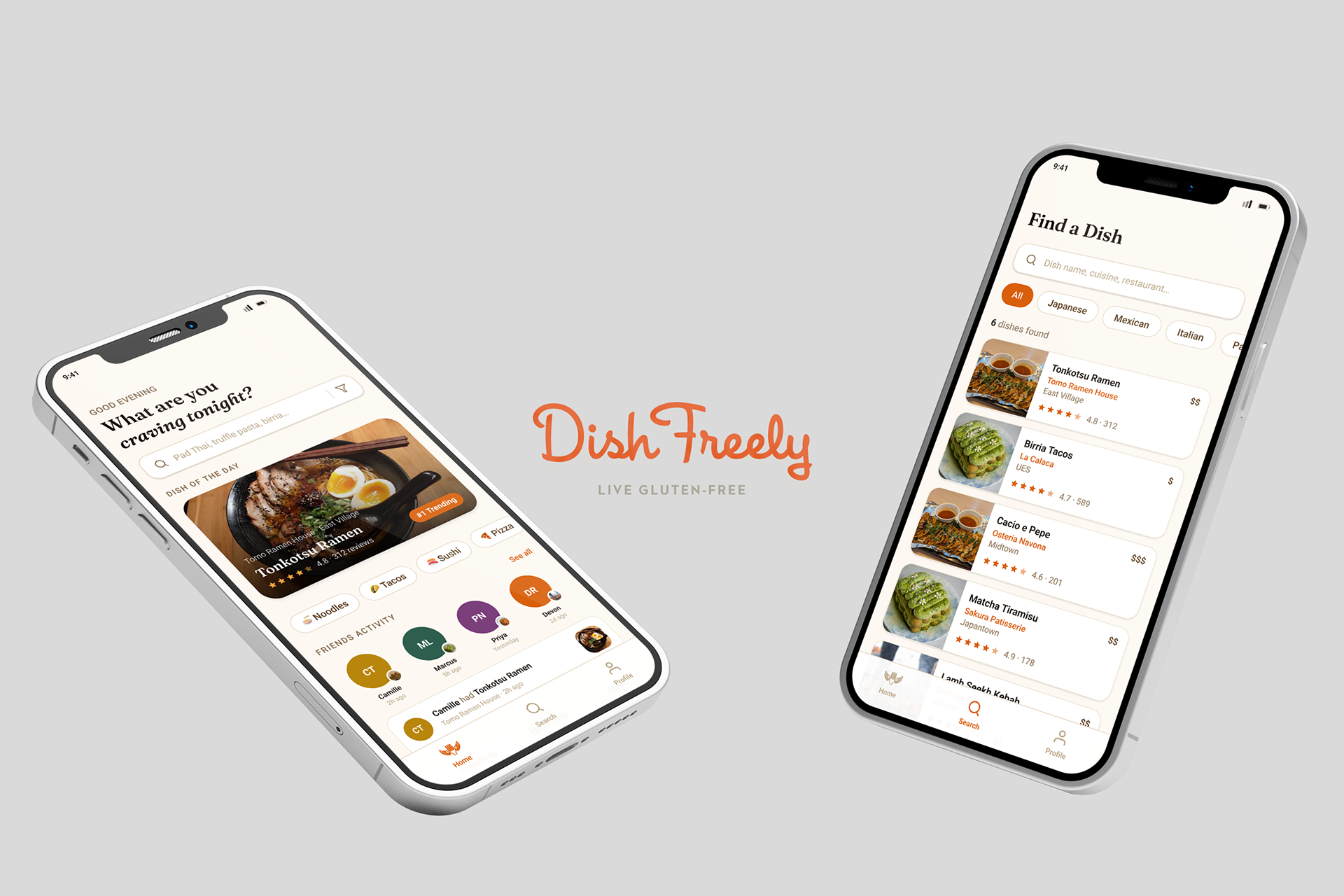
Dish Freely closed in 2012 and none of the original files survive. The screens below are a 2026 reconstruction, rebuilt from memory to think through what we got right and what we got wrong.
Summary
My first startup experience was thinking through and building a food app in 2011 for three months. My cofounder and I had a common experience of trying to figure out where to eat with our friends. We settled on this idea: People don't want to know where to eat. They want to know what to order. Every review platform in 2012 rated the restaurant. We thought the restaurant was the wrong unit. The thing you actually decide on is a dish.
The best burger in a neighborhood is frequently sitting inside a restaurant that rates a 3.6 for reasons that have nothing to do with the burger.
What we did
We did a quick qualitative test using TestFlight with a deliberately narrow group: people with celiac disease and other gluten restrictions. The hypothesis was that if anyone thought in dishes rather than restaurants, it would be them. For someone who can't eat gluten, restaurants that are entirely gluten free are (or were) rare. So the dishes matter.
We ran a feedback session at a bar with a deep gluten-free beer list. The response was strong with anecdotal feedback.
The design
The hardest problem wasn't the dish page, it was browsing. We landed on it by taking the mindset of someone reading a menu rather than someone browsing a directory. Cuisine categories — Japanese, Mexican, Italian — are how restaurants classify themselves. They're not how a hungry person thinks. So the taxonomy became Sushi, Ramen, Tacos, Noodles, Burritos: the thing you're picturing, not the country it belongs to.
Results
We couldn't raise. Without funding, two founders couldn't sustain it, and we stopped.
I still think the bet was right; the mechanism and the timing weren't. Dish-level signal is now ordinary. It lives inside Google Maps, inside apps like Beli, inside food discovery on TikTok. It arrived as a feature of large platforms with existing density rather than as a standalone app. You can easily see the same idea living inside Yelp now, as a feature rather than a product.